Key takeaways
- Factories don’t steal your quality. They fill every blank in your spec with their cheapest default. The spec sheet is where quality is actually decided — not at inspection.
- English-only specs die in translation: the sales rep translates them, not the engineer. A bilingual (English + Chinese) sheet removes the excuse.
- Write the sheet backwards: start from customer returns and low reviews, not from the product drawing.
- Numbers beat adjectives. “Strong frame” is nothing; “150 kg load, paint cross-cut tested” is something.
- The three lines that prevent most disputes: odor/VOC, paint & load with explicit numbers, and noise & damping system named by type.
9.9 out of 10 on JD.com, 144 verified buyer reviews. When people ask where my spec sheets come from, I tell them: from the 1%. The low reviews on my own treadmill listings were the most honest QC report I ever received — and I turned every complaint into a line on the specification sheet I sent to the next factory.
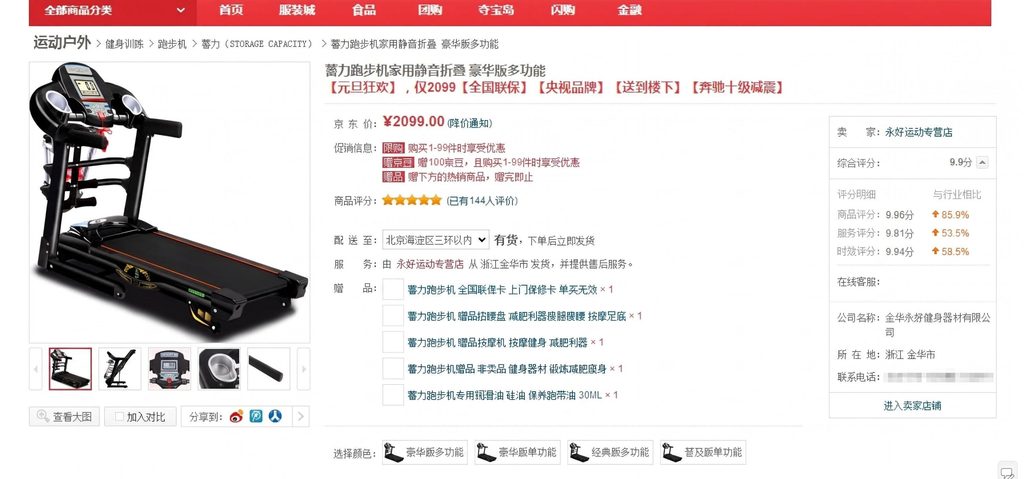
I sat on both sides of this table. As the GM of a fitness-equipment company in Jinhua, I placed OEM orders with Zhejiang factories, then sold the goods on Tmall and JD. My customers told me, in public, exactly where my specs had blanks. This is the system I now run for overseas buyers: a bilingual, numbered, signable OEM spec sheet.
Why factories “misread” specs (they don’t — they fill in the blanks)
Here is the uncomfortable truth about OEM quality disputes: the factory usually didn’t ignore your spec. It followed every word of it — and then made one hundred small decisions your spec never covered. Which grade of paint. Which damping material. Which thickness of deck. Every blank you leave gets filled with the cheapest option that passes nothing.
And “multi-function,” without a list, means the cheapest function set the factory already buys in bulk.
There is a second failure layer: your English spec is translated by the sales rep who wants the order, not by the engineer who runs the line. By the time it reaches the production floor, “durable finish” has become a shrug. A spec sheet is not a description of your product. It is a list of the ways the factory is not allowed to save money.
Write the sheet backwards: start from the returns
Most buyers write specs forward, from the drawing. I write them backward, from the complaints. When I read my JD reviews, the low ones clustered in four places: odor out of the box, noise at speed, paint chipping at the edges, and wobble above a certain pace.
Each complaint became a spec line. Odor became the VOC line. Noise became the damping-system line, naming the acceptable systems. Chipping became the paint-process line with a load number attached. Wobble became the frame and concentric-shaft line. Your customers are your QC department. They just bill you later.
Eight lines that earn their keep
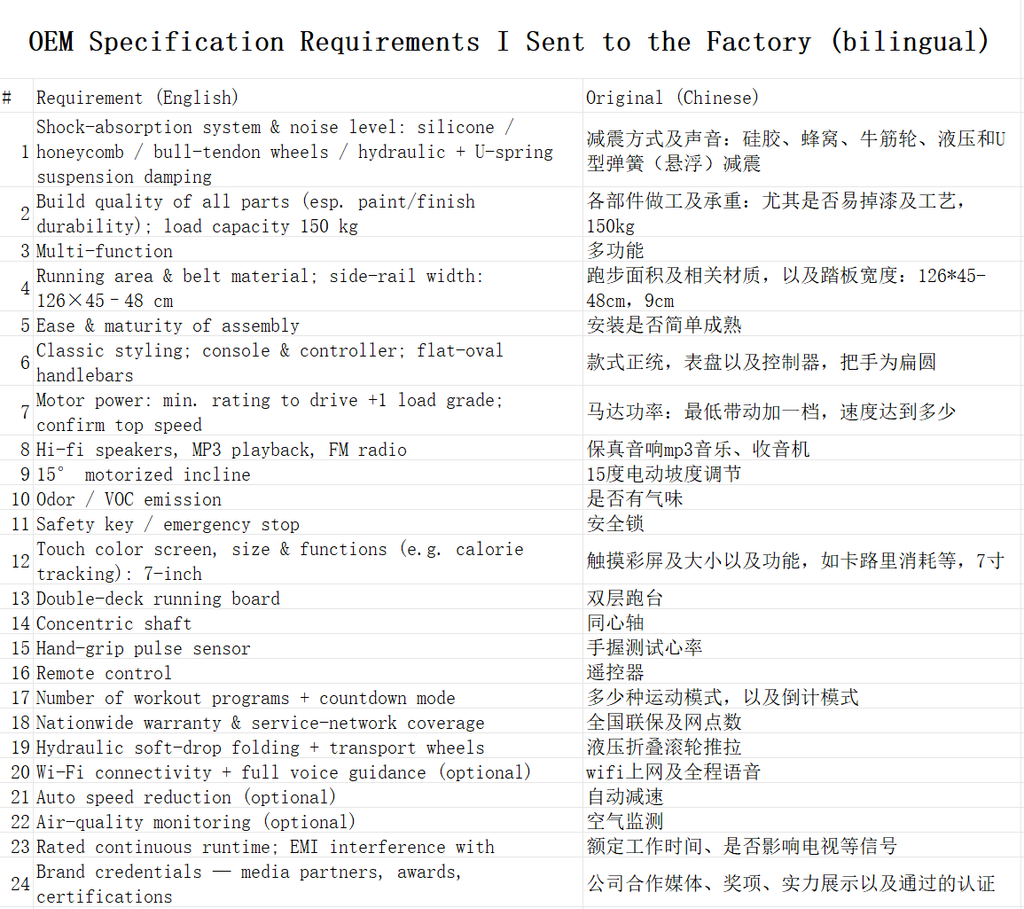
My full sheet for that product ran 24 lines. These eight are the ones that paid for themselves, shown exactly as I send them — English and Chinese side by side:
| Requirement (English) | Original (Chinese) | Why this line exists |
|---|---|---|
| Shock-absorption system & noise level: silicone / honeycomb / bull-tendon wheels / hydraulic / U-spring suspension damping | 减震方式及声音:硅胶、蜂窝、牛筋轮、液压和U型弹簧(悬浮)减震 | Noise is return reason #1. Name the systems; never write “quiet.” |
| Build quality of all parts (esp. paint/finish durability); load capacity 150 kg | 各部件做工及承重:尤其是否易掉漆及工艺,150kg | Adjectives die in disputes; numbers survive. |
| Running area & belt material; side-rail width: 126 × 45–48 cm | 跑步面积及相关材质,以及踏板宽度:126*45-48cm,9cm | Ranges force a written answer you can measure at inspection. |
| Odor / VOC emission | 是否有气味 | The smell complaint arrives 30 days after the container lands. Too late to fix. |
| Safety key / emergency stop | 安全锁 | Compliance and liability, not cosmetics. |
| Motor power: min. rating to drive +1 load grade; confirm top speed | 马达功率:最低带动加一档,速度达到多少 | Makes the factory declare its margin instead of hiding it. |
| 15° motorized incline | 15度电动坡度调节 | A feature either exists in writing or it doesn’t exist. |
| Rated continuous runtime; EMI interference with TV signals | 额定工作时间、是否影响电视等信号 | The line nobody writes — until a forum post writes it for you. |
The three lines that prevent most disputes
Odor / VOC. Smell is the complaint you cannot fix remotely. You cannot air out a container in a customer’s living room. Either the sheet says the materials must pass an odor threshold, or you are gambling.
Paint and load, with numbers. “Good quality frame” is not testable. “150 kg load” and a named paint process are. When the inspector finds chipping, the question is not “is this good enough?” — it is “does it match the sheet?”
Noise and damping, named by system. “Quiet operation” is an opinion; silicone versus honeycomb is a fact. Naming the acceptable systems turns the noisiest complaint category into a checkbox.
Bilingual or bust: why the Chinese column matters
The English column is for you; the Chinese column is for the production boss. When both languages sit side by side, the sales rep can no longer translate your “durable” into whatever wins the order — the boss reads the same numbers you do.
Then make the sheet part of the contract: attached to the proforma invoice, stamped. A stamped spec sheet is also your inspection checklist — my pre-shipment inspections run line by line against exactly this document. And one warning: the Chinese must be written by a native speaker who knows manufacturing vocabulary. Machine translation of technical terms does not remove blanks; it creates new ones.
Spec decisions are freight decisions
One last thing the sheet controls that buyers never expect: your landed cost. On that treadmill project, the manual-incline model cartoned at 1910 × 870 × 330 mm and loaded 104 units per 40HQ. The motorized-incline version needed a carton 5 cm taller — 1910 × 870 × 380 mm — and loaded 91 units.
Five centimeters of carton height cost 13 units per container. Spread your ocean freight over 91 units instead of 104 and the “cheaper” spec is suddenly the expensive one. Lock the specs, then the carton, then compare quotes — the sequence matters. (The quote-comparison side of this is written up in the RFQ comparison guide.)
Quick answers
How long should an OEM spec sheet be?
As long as your complaint history. A first product usually runs one to three pages; my treadmill sheet ran 24 numbered lines. Cover every complaint you have ever received or can anticipate — and number every line so inspection can cite line numbers.
Should I send the spec in Chinese only?
The Chinese column is the most lossless version for the factory floor, but keep the English column as your contractual language. Side by side, stamped, attached to the PI.
What if the factory hesitates to stamp specific numbers?
That hesitation is data. A factory confident in its process stamps 150 kg without blinking. One that argues over every number is telling you where it planned to cut.
If you have a product and a complaint history (or just a target spec), send it over — I will turn it into a bilingual, signable sheet before your next quote round. The full vetting process behind factory selection is in the manufacturer vs trading company guide.

Founder & Sourcing Director at Clari Sourcing, based in Guangzhou. 10+ years of factory sourcing, negotiation and quality control experience, helping importers and Amazon sellers buy from China with confidence.