Key takeaways
- In China, products cluster by city. Your sourcing agent should sit next to your product, not in a convenient city.
- Shenzhen for electronics and prototypes. Guangzhou for apparel, fabric, cosmetics. Yiwu for small commodities and low-MOQ consolidation. Foshan for furniture, lighting, ceramics.
- A Shenzhen sourcing agent is the right call for a PCB order and the wrong call for a sofa order. Travel time is where money leaks.
- The question that matters isn’t “where is your agent’s office?” It’s “how many hours from my factory’s door?”
A buyer in Europe emailed me last month: should he hire a Yiwu sourcing agent, or is a Shenzhen sourcing agent fine? He was buying stainless steel kitchenware. The honest answer was neither. Kitchenware clusters in Chaozhou and Jieyang, on the east side of Guangdong. The city on your agent’s business card should match your product’s cluster, or you’re paying for train tickets and finding out about problems a day late.
Here’s the rule this whole article hangs on: in China, products live in clusters. Foreign buyers searching “sourcing manufacturers in china” usually discover that rule the expensive way. Once you accept it, the city question answers itself.
Why the cluster decides the city
An agent’s real value isn’t email. It’s speed on the ground: walking the production line, pulling a bad sample off the table, sitting across from the boss when the timeline slips. If your agent is forty minutes from the factory, a problem found Tuesday morning is fixed by lunch. If your agent is a province away, the same problem waits a day — and the line keeps running bad product the whole time.
A defect caught early is cheap. The same defect caught three days later is a container.
Clusters also run on local relationships. The agent who works your cluster every week knows which boss actually delivers and which one subcontracts. That knowledge doesn’t exist in a database. It exists in a city.
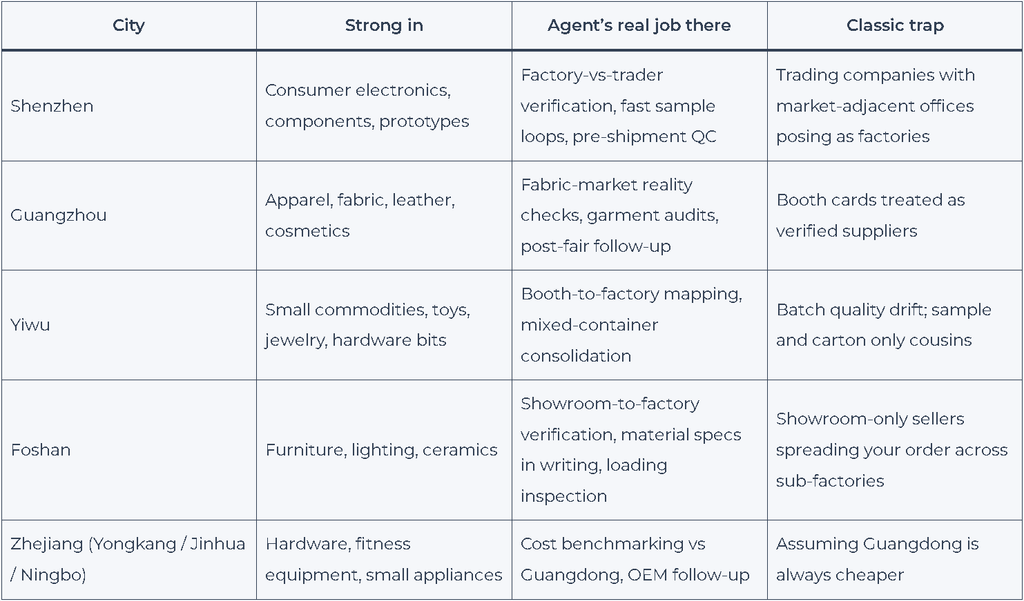
Shenzhen: electronics, prototypes, and the trading-company trap
Consumer electronics, components, prototypes that iterate in days — that’s Shenzhen, with Huaqiangbei’s component markets and the factory belts in Bao’an and Longgang. If you’re sourcing anything with a PCB in it, this is the city, and Dongguan next door handles a lot of the assembly.
The trap: Shenzhen may have more trading companies posing as factories than any other city in China. An office near the market, a website full of product photos, a quote that sounds right — none of it means there’s a factory behind it. This is exactly where registry checks and a walk through the actual production floor separate the real ones from the resellers. I wrote up the full verification process in this supplier due diligence case study.
I’m based in Shenzhen, so I’ll say the quiet part out loud: a Shenzhen sourcing agent is the right call for your electronics order and the wrong call for your sofa. Judge your agent by what their city is actually good at.
Guangzhou: apparel, fabric, cosmetics — and the Canton Fair rhythm
Garments, fabrics, leather goods, cosmetics. The Zhongda fabric market runs for kilometers and quietly sets the tone for what apparel factories can actually make this season. Garment factories sit in Panyu, Baiyun and the surrounding towns; cosmetics cluster in Baiyun.
Guangzhou also hosts the Canton Fair twice a year, which explains a lot of the search volume around “guangzhou sourcing agent.” Here’s the field truth about the fair: a business card collected at a booth is marketing, not verification. The agent’s job starts after the fair — turning two hundred cards into ten factory audits into three suppliers.
Yiwu: the market city, and what low MOQ actually means
Yiwu’s Futian market is tens of thousands of booths of small commodities: party supplies, toys, jewelry, hardware bits, kitchen gadgets. It’s the right city when your order is small and mixed — twenty SKUs in one container, a few cartons each. That consolidation is Yiwu’s real superpower, and it’s why buyers with young product lines hire a Yiwu sourcing agent before they hire anyone else.
Two realities to manage. One: a booth is a sales window, not a factory. The goods may come from Jinhua, Dongyang or farther out; your agent’s job is mapping booth to real factory before money moves. Two: in commodity land, quality drifts between batches. The sample you approved and the carton you receive can be cousins, not twins. Inspect before loading, every time.
Foshan: furniture, lighting, ceramics — and the showroom illusion
Furniture runs along the Lecong corridor, lighting clusters in nearby Guzhen (Zhongshan), ceramics in Shiwan and Nanzhuang. If you’re building a furniture line or furnishing a project, a Foshan sourcing agent — or one stationed there for the season — is the move.
The illusion here is the showroom. Foshan has some of the best furniture showrooms on earth, and a good number of them are run by sellers with no factory of their own. Your order gets spread across sub-factories for frame, foam, fabric and hardware, and specs drift between those subs. The leather you picked becomes “similar leather.” This is the category where pre-shipment inspection pays for itself most reliably, and where I insist on material specs in writing before bulk production.
Don’t skip Zhejiang: hardware, fitness, and the Yongkang belt
One more cluster buyers miss. I ran my own fitness-equipment company out of Jinhua years ago, placing OEM treadmill orders with factories in Yongkang and Wuyi. If your product is hardware-adjacent — gym equipment, power tools, door hardware, some kitchenware — Zhejiang beats Guangdong on cost. Ningbo adds small appliances and plastics on top.
Yiwu is in Zhejiang too, which makes the province a two-city play for commodity-plus-hardware buyers.
One agent, or one per city?
You don’t need four agents. You need one accountable agent who travels. Whether you call it a china purchasing agent, a buying agent or a sourcing agent, the job description is the same: be at your factory’s door when it matters. I’m based in Shenzhen, work nationwide, and can station in one city for long projects — the arrangement most repeat clients end up on.If that’s what you need, here’s what my sourcing service covers.
The right interview question for an agent isn’t “where is your office?” It’s “how many hours from my factory’s door are you, and will you go there this month?”
Quick answers
Which city is best for sourcing electronics in China?
Shenzhen for components and consumer electronics, with Dongguan for assembly-heavy orders. Prototype turnaround in Shenzhen is measured in days, not weeks.
Is Yiwu good for small MOQ orders?
Yes. The market plus consolidation infrastructure makes Yiwu the best city for mixed, low-MOQ containers. Expect batch quality variance and inspect before loading.
Does my sourcing agent need to live next to my factory?
No. But they need to reach the factory door same-day or next-day, and actually go. Distance you can’t close quickly is where defects and delays hide.
Next: GOTS-certified kidswear in China — why the certificate you need doesn’t exist at the MOQ you want.

Founder & Sourcing Director at Clari Sourcing, based in Guangzhou. 10+ years of factory sourcing, negotiation and quality control experience, helping importers and Amazon sellers buy from China with confidence.