Key takeaways
- Supplier due diligence in China means verifying four things before money moves: legal existence, business scope, authorization, and export compliance.
- I contacted 20+ Chinese suppliers in a few days for one order. Four survived the paper checks. One was caught misstating its authorization.
- The single most effective verification move was a phone call to the brand’s China office, reading the supplier’s claims back verbatim.
- A certificate that only appears after you pay a deposit is not a certificate.
The supplier told my client he was authorized to sell BITZER screw compressors. BITZER China told me he wasn’t.
The call that proved it took four minutes to arrange. On the other side of the deal, a Chilean buyer was about to wire a deposit to a company misstating its authorization, for stock whose export route the brand explicitly restricts. Nobody was going to tell him that over email. Suppliers don’t volunteer the information that kills a deal.
This is the full process I ran on that project, written up the way I actually work: the funnel, the registry checks, the authorization paper, the brand call, and the red flags that ended up mattering. Company names are redacted. The process isn’t.
The brief: genuine compressors for a buyer who had been burned
The client, an industrial buyer in Chile, needed CSH8583-125Y-40P screw compressors. He had already been circling grey-market stock and knew enough to be nervous. His ask was simple: find genuine sources, and prove what each supplier actually is.
“Prove” is the operative word. Any supplier can send a PDF. My job was to build a paper trail for each one, then test that paper trail against reality.
Step 1: Wide funnel first, opinions later
I contacted more than 20 Chinese distributors and traders inside a few days. Not four, not six. Twenty-plus.
The reason is simple: you can’t judge a market you haven’t seen. With 20+ conversations on the table, patterns show up fast — the normal lead time (3–4 weeks made-to-order), the normal payment split, the normal price band. Outliers stop being invisible.
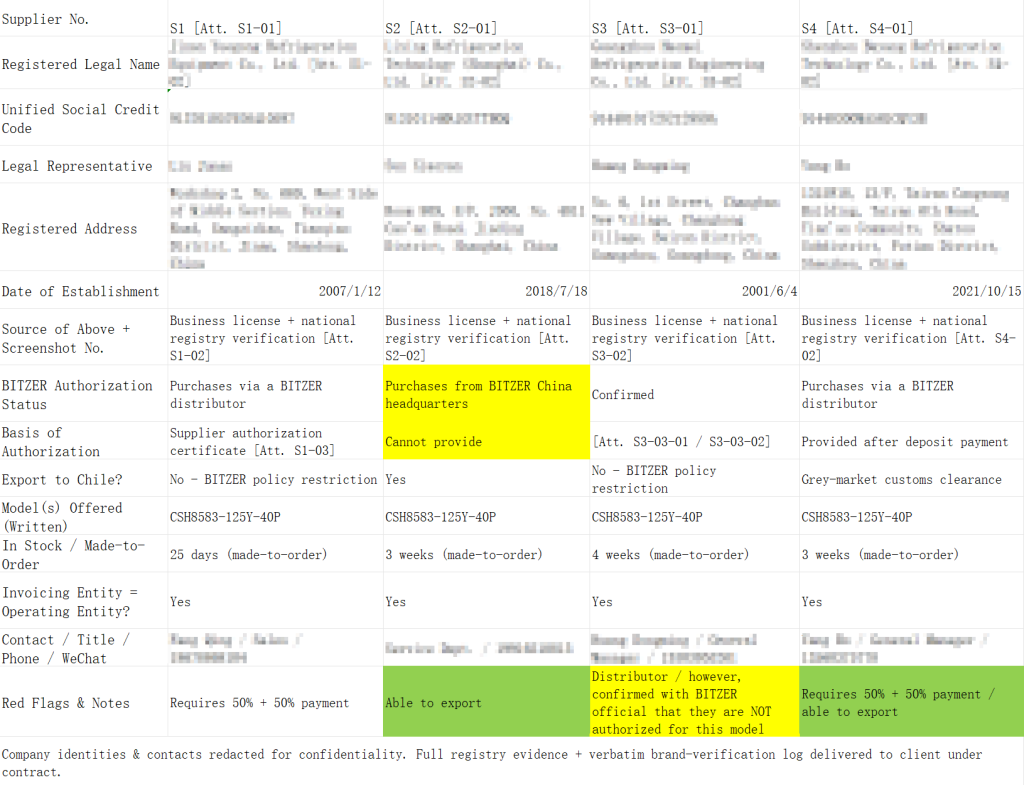
From that funnel, four suppliers made the shortlist: two sourcing through BITZER distributors, one claiming confirmed authorization, one claiming to buy “from BITZER China headquarters.”
Step 2: The 10-minute registry filter most buyers skip
Every Chinese company has an 18-digit Unified Social Credit Code (USCC), searchable on the national registry, the National Enterprise Credit Information Publicity System. Before I talk price with anyone, I pull:
- Date of establishment. A 2007 company and a 2021 company are different risk profiles. Both can be fine. Both can be a problem. But I want to know which one I’m talking to.
- Business scope. “Production/manufacturing” in the scope means the company may actually make things. “Sales/trade” only means I’m talking to a middleman — fine if he admits it, a problem if he doesn’t.
- Registered address vs. real address. An unexplained mismatch is a flag. If the two differ, I ask for a live video walk of the office or factory.
I don’t negotiate price before this check passes. A price from a company you haven’t verified is not a quote. It’s a number.
Step 3: Authorization paper, and the two ways it fails
For branded products, the authorization question is the whole game. The four shortlisted suppliers broke down like this:
| Supplier | Claim | Paper | Payment terms | Read |
|---|---|---|---|---|
| A | Sourced via a BITZER distributor | Distributor authorization certificate on file | 50% + 50% | Viable. Negotiate terms |
| B | “We buy from BITZER China headquarters” | Cannot provide the certificate | — | Out. A claim with no paper is a claim |
| C | Confirmed authorized | Certificate verified against registry records | — | Viable on paper. The brand call later changed the picture — see below |
| D | Sourced via a distributor | Authorization “provided after deposit payment” | 50% + 50% | Out. Grey-clearance exporter |
Two failures worth naming:
The missing certificate. Supplier B’s story was elegant: we buy from the brand’s own headquarters. Great story. No document. When authorization can’t be produced before money moves, the story is doing the work the paper should do.
The after-deposit certificate. Supplier D said authorization documents would appear after the deposit. Think about that for a second. A document that materializes only after you’ve paid is not evidence of anything except your payment.
Step 4: Call the brand. Read the claims verbatim.
Here is the move most agents won’t do and most buyers don’t think to ask for: call the brand’s China office and read the supplier’s exact claims back to them.
I reached BITZER China’s general manager and logged the answers verbatim:
Me: Has the CSH8581-125Y-40P been discontinued? Can it still be ordered?
BITZER: Already discontinued. The CSH8583 is effectively its upgraded replacement.Me: The ban on exporting single units — is that official written policy?
BITZER: It restricts distributors. Once a distributor has sold the unit, BITZER does not follow up.
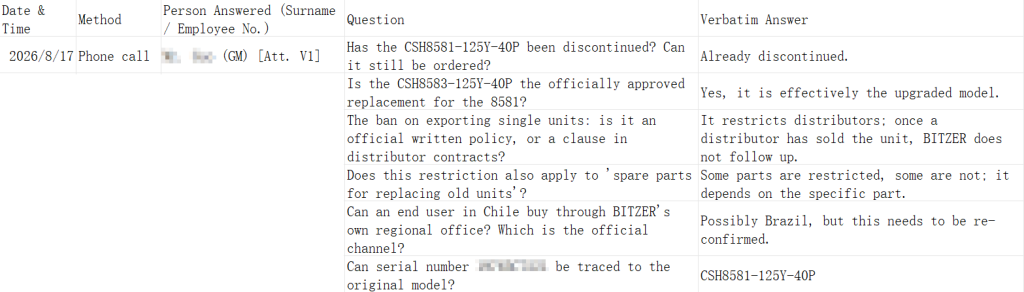
Two answers, and the deal’s entire risk picture changed. The replacement story was clean. The export route was not: what happens after a distributor sells a single unit sits in a grey zone the brand tolerates but does not authorize — which means no warranty, no official support, and a customs story that belongs to the buyer, not the seller.
Four minutes on the phone with the brand beat a week of email with suppliers. I now run this call on every branded-product order.
Due diligence also catches honest suppliers
Here’s the part people forget: due diligence isn’t only about catching liars. Supplier C was authorized, verified, honest. And the brand call still showed that BITZER’s export policy made him the wrong channel for this buyer’s destination.
The client needed that fact more than he needed the liars caught. An honest supplier inside a policy trap is still a trap.
Outcome
The client switched strategy before any money moved. No deposit lost, no grey stock, no customs surprise. His review, verbatim from the platform: “He caught one supplier misrepresenting its authorization and flagged a customs risk on another instead of passing it through. His findings changed our sourcing strategy and saved us a costly mistake.”
This is the same process I run on every supplier vetting project — the only difference is the product.
The checklist I now run on every branded-product order
- Registry first. USCC on the national registry. Age, scope, registered address. Ten minutes, no excuse.
- Match addresses. Registered vs. real. Mismatch without a good story = live video tour or walk away.
- Authorization in writing, before money. Not after the deposit. Before.
- Map the chain. Factory → distributor → trader. Every hop adds margin and removes control. Know your hops.
- Call the brand. Read the supplier’s claim verbatim. Log the answer word for word.
- Check export compliance separately. Model status, export policy, customs route. Grey clearance is your risk, not the supplier’s. He sleeps fine at night.
- Read payment terms as a signal. 100% upfront, or documents that appear only after payment, are not terms. They are tells.
Quick answers
How do I verify a Chinese business license?
Take the 18-digit USCC from the supplier and search it on the National Enterprise Credit Information Publicity System (gsxt.gov.cn). Check legal name, establishment date, business scope, and registered address against what the supplier told you.
Is grey-market export from China risky for the buyer?
Yes. No brand warranty, no official support, and customs exposure sits with the importer. The discount on grey stock rarely covers what it costs when something goes wrong.
Can trading companies sell genuine branded products?
Sometimes, through authorized distributor chains. The chain is exactly what you verify: authorization certificates at each hop, and a brand call at the top.
Next: Shenzhen, Guangzhou, Yiwu or Foshan — where should your sourcing agent sit?

Founder & Sourcing Director at Clari Sourcing, based in Guangzhou. 10+ years of factory sourcing, negotiation and quality control experience, helping importers and Amazon sellers buy from China with confidence.